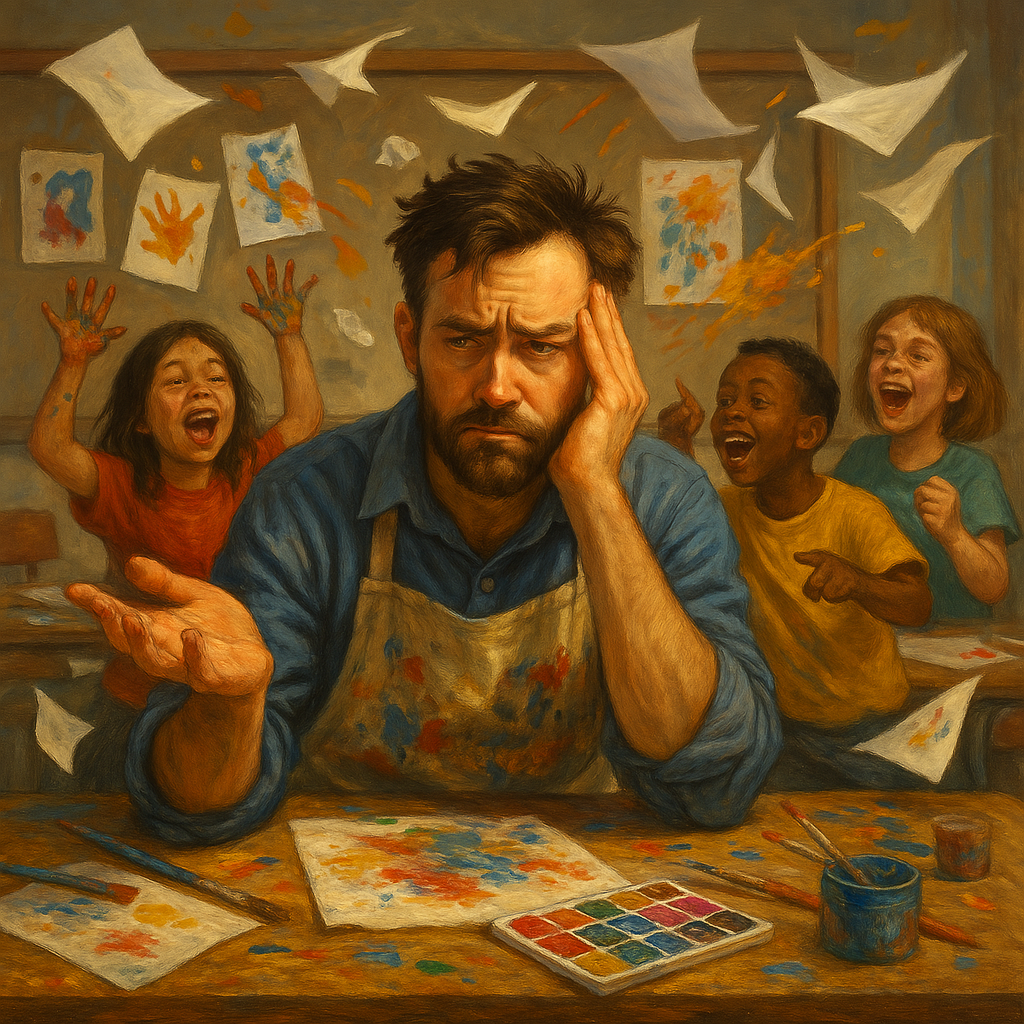
Teaching elementary art is like stepping into a hurricane of glitter (metaphorical, their real teacher will murder me if she finds glitter in the room), emotions, and questionable decision-making. At this age (10–11, give or take a tantrum), kids are simultaneously asserting independence and forgetting how to use a glue stick properly. They push boundaries, challenge authority, and occasionally create art that is 50% “accidental” marker stains, 30% pencil smudges, 10% intention and 10% get it done in the last 30 seconds before cleanup.
For the past few weeks, I’ve been shadowing the current art teacher before she heads out on maternity leave. Technically, she’s still here—holed up in the supply closet organizing pieces for an upcoming art show—but the classroom? That’s mine now. The lesson plans, the learners, the sacred duty of keeping paintbrushes out of mouths.
Until the last day of school, I am the authority.
And that’s a strange thing to reckon with.
Things I Can’t Believe I Say Now
There’s a bizarre déjà vu in standing at the front of a classroom, saying things I once rolled my eyes at as a student:
- “Make sure your name is on your paper.”
- “We can’t move on until everyone is listening.”
- “Is this how we’re supposed to stand in line?”
- “If you rush through it, you’re only cheating yourself.”
I hear these words escape my mouth and wonder—do they think I’m just another adult trying to wear them down? Because I remember feeling that way. I remember being scolded for things I hadn’t done. I remember the frustration of being one of the “good kids” and still losing recess because of the kid who decided to see what happens when you staple your sleeve to the carpet. To me, authority never felt like guidance. It felt like an attempt to exhaust me into submission.
And now, here I am. The authority figure.
The Art of Holding Authority Without Becoming the Villain
I don’t want to be the kind of teacher who enforces rules just for the sake of control. To be clear, that isn’t what I’ve seen modeled in my shadowing experience—but it is what I perceived as a child. I want to give learners the space to recognize their own behavior, to adjust naturally rather than just constantly regulating and reacting to a fear of consequences.
I imagine we all want kids to grow into adults who make good decisions because they want to—not because they hear an imaginary “or else” in their heads every time they have a choice to make.
That said, I’m not naive. Sometimes consequences are necessary. Yesterday, I told a group of fifth graders, “If you can’t follow the group plan inside, then observational drawing outside when the weather is warmer isn’t going to be an option.”
It worked. For now.
But relying only on consequences has its pitfalls. If you keep hammering the same lesson over and over, you don’t just teach compliance—you risk teaching something darker:
- I don’t deserve good things.
- I can’t do anything right.
- My thoughts and feelings don’t matter.
- Everyone hopes I fail.
And the thing is, fear of consequences isn’t sustainable. One day, they’ll realize that consequences can be dealt with. If they’ve been conditioned to endure them regularly, those consequences lose their power. Then you get rebellion—not the fun, inspirational kind of “good trouble”, but the kind that makes people quit jobs, break laws, or, at minimum, make spectacularly bad life choices in the name of defiance, resentment, and spite.
So the real challenge: How do you trust that kids can regulate themselves—when, developmentally, they haven’t yet figured out how to close a bottle of glue before shoving it in their backpack?
The Weekly Shape-Shifting of Children
Art is supposed to be a space for freedom, exploration, and controlled mess. But without structure, it turns into a dystopian wasteland of broken crayons and emotional breakdowns. Every day, I’m trying to find the balance.
One week, they’re engaged, helpful, and creative. The next, they’re making paper airplanes and re-enacting a fart symphony.
So when a student refuses to listen, do I give them space to figure it out, or do I impose discipline?
When another student is frustrated by the chaos, am I failing them by not being firmer?
I suspect experience will make this easier. Already, I’m more sure-footed than I was last week. The classes I dreaded are starting to regulate themselves. Meanwhile, the ones I thought were solid have begun to unravel because I felt I could loosen my grip on the reins with them. They’re wildly unpredictable.
Maybe that’s the key—meeting their energy with a little (safe) unpredictability of my own.
Here’s what I mean by that…
A Lesson in Authority from a Handful of Paint

The other day, a sixth grader sat at the back of the room during studio day—a time when students get to experiment freely with materials. As I made my rounds, I noticed their body go rigid, one hand suspiciously hidden under the table.
I braced myself. This is not how I wanted to start the day.
“What are you working on?” I asked.
A hesitation. “I was just painting.”
I nodded. “I’m a painter too. Need help?”
Slowly, they pulled their hand out from under the table. It was completely covered in navy blue paint, streaked with red and yellow. The look on their face said they were bracing for doom.
And I get it. I’ve been in their shoes. Most teachers I had would have immediately shut it down:
- “That’s not okay.”
- “This is not what paint is for.”
- “You’re setting a bad example.”
But here’s what I saw:
- They weren’t bothering anyone.
- They weren’t ruining their clothes.
- They weren’t painting other students.
- The paint was washable.
So, I said:
“I really like the color combination and the mirror effect where your hands crease … are you done?”
A look of cautious confusion.
“You can keep going if you feel like you’re onto something—just keep it on your hands or paper and wash up when you’re finished.”
For the rest of class, they experimented with palm prints, layering them into a cool abstract piece. At the end, they proudly took it home.
My hope? That next time, instead of hiding what they’re doing, they’ll know that it’s safe to ask me. That they’ll trust that my answer will be based on more than just whether or not I want them to.
This moment could go one of three ways:
- It sparks a passionate pursuit. Maybe this was the start of something—a love for body painting, printmaking, special effects makeup, or performance art. Maybe they’ll research techniques, practice at home, document their work. Maybe they’ll find a creative identity in this, one that helps them connect with others. Maybe they’ll become the world’s most renowned hand stamper and they’ll thank me in an awards speech. (A little delusion is ok).
- It fizzles out. The hand-painting curiosity, no longer “off-limits,” loses its appeal. The mystery is gone. Turns out, painting your hand isn’t that exciting after all. They move on. And that’s just as important—to learn that not every impulse leads to something profound.
- It becomes the problem it had the potential to be. Next week, they might push it too far—turning it into a spectacle, disrupting class, painting their friend’s arm against their will. If that happens, I’ll have to intervene. And that’s fine. Authority is warranted when responsibility is lacking.
But in that moment?
I had a chance to reinforce something: creative curiosity isn’t dangerous.
Authority doesn’t have to be a hammer waiting to strike.
And maybe I showed them that creativity isn’t about avoiding trouble—it’s about discovering possibilities.
Could this backfire? Absolutely. I might regret this if we have to shift the discussion. But if every decision I made was based on the potential for chaos, I’d be ruling by my fear. And isn’t that the real problem?
Weaponized Authority and an Assassination in the Cul-De-Sac
The other day, it hit me: Some of my earliest memories with authority figures were so damaging that even now, as a 39-year-old adult, I hesitate to take up space in that role. In addition to that, I’m realizing that my approach to authority is a unique alchemy of the handful of teachers I had throughout my life who were the authority figure I needed and respected, they just came later in my academic career.
I want to be gentle. I want to be patient. I want to trust that kids can regulate themselves when given the space to do so.
But also… I know that’s delusional.
Kids are dealing with a million things—social dynamics, home life, weird hormonal shifts. Expecting perfect behavior every day isn’t just unrealistic—it’s unfair.
My previous experience in education was mostly with high schoolers. My approach back then as a twenty something grad student?
“I’m going to treat you like an adult until you give me a reason not to.”
With older students, it usually worked. ESPECIALLY if it was just me and them. I tolerated a healthy amount of their shenanigans, and in return, they usually listened when I said it was enough. But I also worked with people who had zero tolerance for youthful nonsense. When they brought the hammer down, I saw how it shattered the relationships and rapport I had built and often felt like I was being disciplined right along with them.
Authority wielded like a weapon doesn’t teach lessons—it teaches resentment. Learning and retention drastically improve when we are having fun. That’s like, science you guys. That to me means we have to make allowances for their fun if we want learning to occur. My best friend whom I’ve known since grade school, and without whom this blog wouldn’t even exist (her contributions to my life are vast and invaluable), turns 40 today. When we get together to celebrate, do you think we are going to reminisce about all the stuff we memorized in total silence because Mrs. Whatshername made us sit in a dark room and re-write the same sentence over and over because a few people were disruptive?
Absolutely not. We probably won’t even mention Mrs. Whatshername.
We are going to laugh about the time we made a WWI “comedentary” though. We filmed a re-enactment of the assassination of Archduke Franz Ferdinand in her cul-de-sac, while I dodged and weaved dressed like Austin Powers, (is he not the world’s foremost Secret Agent Man?). We did that for Mr. G’s class and last I heard, he was still showing it to his AP Euro students as an example. I wonder how he is? Maybe I’ll pay him a visit. Hope I don’t run into Mrs. Whatshername.
A Question for Reflection

Where did your earliest perceptions of authority come from?
Did they teach you structure and self-awareness, or just compliance?
And if you had to step into an authoritative role today, how much of your past would shape the way you lead?As for me, I’m still figuring it out but there is definitely a right time to let a kid paint their hand
Leave a Reply